Issue #19 — Your ADHD Isn't One Condition — Brain Scans Just Revealed Three
🎯 TL;DR
For the first time, neuroscientists have used brain scans — not symptom checklists — to prove ADHD is three biologically distinct conditions. If you're a founder, the biotype running your company predicts your pitch-room blowups, your impulsive pivots, and your hiring mistakes. This week you'll learn how to spot which one you are and build the decision-making buffer that keeps it from torching your runway.
This week: The MRI study that breaks the "ADHD is one thing" myth — and what founders should do about it.
Read time: 6 minutes
🧠 The Pitch Meeting That Shouldn't Have Imploded
You're three minutes into a Series A pitch. The partner across the table says, "I'm not sure the wedge is sharp enough." A normal founder hears feedback. You hear contempt. Your jaw locks. You hear yourself say something that, in the elevator afterward, you can't quite remember but you know was bad. Your co-founder won't look at you for the rest of the day.
I've watched this happen to brilliant founders maybe forty times in the last decade. Every single one of them had ADHD. And every single one assumed the explosion was a character flaw — proof they're "too much," that they can't be trusted in rooms with adults. New brain imaging research suggests it's not a character flaw at all. It's a specific subtype of ADHD with measurable physical differences in the brain. And until last month, we didn't know it existed as its own thing.
🔬 What 1,154 MRI Scans Just Proved
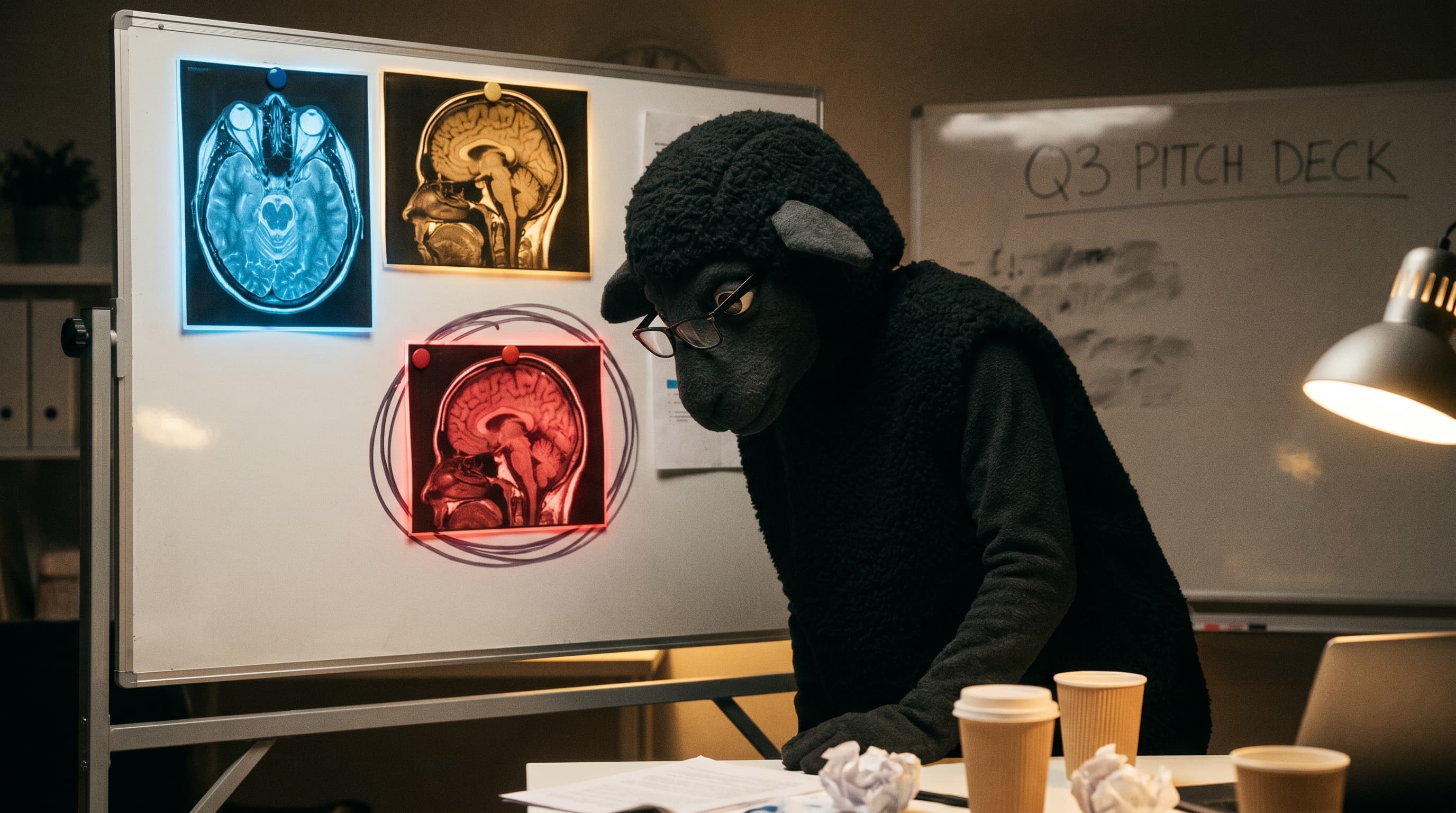
On April 30, 2026, JAMA Psychiatry published a study that quietly upended how we think about ADHD. Researchers ran morphometric analysis on 1,154 MRI scans from the IMAGEN and ABCD cohorts and identified three structurally distinct ADHD biotypes — the first time anyone has carved up ADHD using actual brain anatomy instead of the DSM-5's symptom-counting exercise. The Washington Post's May 8, 2026 coverage by Lenny Bernstein called it "the most significant rethink of ADHD diagnosis in thirty years."
The three biotypes don't map cleanly onto the old "inattentive vs. hyperactive vs. combined" buckets. They split along different brain regions entirely — frontal-striatal circuits, default mode network thickness, and the limbic structures (amygdala, anterior cingulate) that handle emotional regulation. Biotype 3 — the "severe-combined / emotional dysregulation" group — showed the most dramatic limbic differences and clinically reported the most outsized responses to perceived rejection, criticism, and uncertainty. About 21% of the sample fell into this group, and they were more likely to also meet criteria for what clinicians have been informally calling RSD (rejection-sensitive dysphoria) for years.
"These biotypes weren't visible on any symptom checklist. They only emerged when we stopped asking patients what they felt and started measuring what their brains actually looked like." — Dr. Qing Zhao, lead author, JAMA Psychiatry, April 30, 2026
Here's the rough breakdown of what they found:
| Biotype | Brain Signature | Behavioral Profile | Founder Risk |
|---|---|---|---|
| Biotype 1 — Inattentive-cognitive | Reduced prefrontal cortical thickness; weak fronto-parietal connectivity | Distractibility, working memory gaps, time blindness | Missed deadlines, dropped follow-ups, calendar chaos |
| Biotype 2 — Hyperactive-impulsive | Striatal volume differences; altered reward circuitry | Novelty-seeking, impulsive action, dopamine chasing | Premature pivots, shiny-object hiring, over-commitment |
| Biotype 3 — Severe-combined / emotional dysregulation | Amygdala and anterior cingulate differences; weaker top-down emotional control | Volatile reactions, RSD, conflict spikes, shame loops | Pitch-room blowups, co-founder breakups, churned key hires |
If you've been told for twenty years that "ADHD is ADHD," this table should feel like an explanation finally arriving on time.
🛠️ Building the Buffer for Your Biotype
You can't get an MRI before your next board meeting. But you can self-locate honestly and engineer around your dominant pattern. Here's how to build decision-making buffers calibrated to each biotype:
-
If you're Biotype 1 (inattentive-cognitive): Build capture infrastructure, not willpower. Voice-memo every commitment within 30 seconds of making it. Run a daily 10-minute "open loops" review. Refuse to make any decision involving more than three variables without writing them down. Your bottleneck isn't motivation — it's working memory bandwidth. Treat it like RAM and externalize aggressively.
-
If you're Biotype 2 (hyperactive-impulsive): Install a 48-hour rule on every major decision — hires, pivots, fundraise terms, product cuts. Write the decision down on Day 0. Look at it again on Day 2 before executing. Roughly 60-70% of your "obvious" moves will look different after the dopamine spike fades. Your enemy is the felt-sense of urgency that isn't actually urgent.
-
If you're Biotype 3 (severe-combined / emotional dysregulation): Build emotional latency into high-stakes inputs. Never respond to investor feedback, customer churn emails, or co-founder critique in real time. Set a hard rule: minimum 4 hours between receiving emotionally-loaded information and any outbound communication about it. Tell your team this rule explicitly — "If I get sharp in a meeting, call a five-minute break." Your amygdala is faster than your prefrontal cortex; the buffer is just compensation for that lag.
-
For all three: Tell your co-founder which biotype you suspect you are and what your specific failure mode looks like. This isn't oversharing — it's operational disclosure. A co-founder who knows your wiring can catch the blowup before it costs you a term sheet.
⚡ The ADHD Angle
Here's why this matters more for founders than for almost anyone else. The startup environment is a near-perfect trigger machine for Biotype 3: constant rejection (investors, customers, candidates), constant ambiguity (will this work?), constant social evaluation (am I a real CEO yet?). If your limbic system runs hot, every fundraise becomes a six-month neurological assault. The "bad founder" stories you tell yourself after a blowup aren't moral failures — they're the predictable output of a brain whose emotional regulation circuitry is anatomically different.
The dopamine angle is just as important. Biotype 2's striatal differences mean reward-seeking isn't a vice — it's a structural feature. That's why you started a company in the first place. The same circuitry that made you brave enough to quit your job is the circuitry that makes you want to rebuild the product on a Tuesday night because a Reddit thread excited you. Hyperfocus isn't free. It's borrowed against future executive function, and Biotype 1 founders pay that bill in dropped follow-ups and forgotten promises. Knowing which loan you're taking out lets you actually budget for it.
🎯 This Week's Challenge
Do these three things before Sunday:
- Self-locate. Read the biotype table again and write down which one feels like 70%+ of your operating pattern. Be honest, not flattering. If you're unsure, ask your co-founder or partner — they know.
- Pick one buffer from the Practical section and install it this week. Just one. The 48-hour rule, the 4-hour emotional latency, or the open-loops review. Put it in your calendar as a recurring event.
- Send one message to a co-founder, key hire, or partner that says: "Here's the failure mode I'm most prone to, and here's the signal you should give me when you see it starting." Operational disclosure beats apology every time.
See you Tuesday, L-P
P.S. — If this issue made something click, forward it to the founder friend whose pitch blowups you've quietly been worrying about. They probably think they're broken. They're not. They just got handed a Biotype 3 brain and a startup at the same time. Reply and tell me which biotype you landed on — I'm collecting responses for a follow-up issue.
Divergent — Strategy for brains that don't do boring.